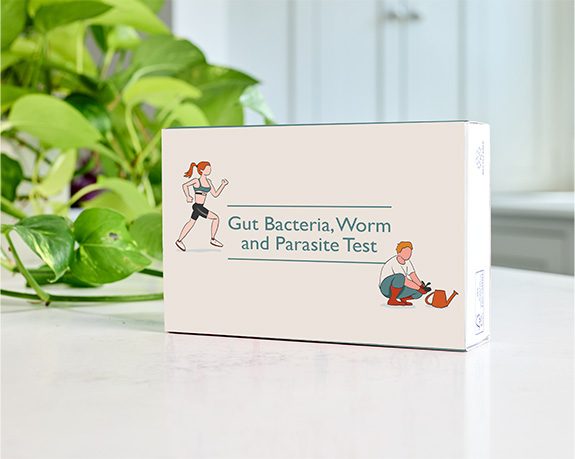
Advanced Gut Bacteria, Worm and Parasite Test
Upgrade to the advanced pathogen profile test for a more comprehensive analysis of gut infections.
- At-home test
- Doctor reviewed
- 24 biomarkers
- Results in 5–6 days
Worried about gut symptoms that you think might be related to a parasite, worm or bacteria? Our Gut Bacteria, Worm and Parasite Test detects the most important culprits.
7 biomarkers as listed by Selph.
Take our Gut Bacteria, Worm and Parasite Test if you're concerned that you may have a bowel infection with a bacterium, worm or other parasite.
Take your stool sample at home and send it to our NHS-testing lab to check for common bacteria, Giardia and Cryptosporidium as well as roundworms, flatworms, tapeworms and other parasites.
Gut infections are a common cause of bowel symptoms such as diarrhoea, stomach pain, bloating and nausea.
Our Gut Bacteria, Worm and Parasite Test checks for common and important gut infections caused by bacteria, parasites and worms. We use highly sensitive DNA-based PCR to test for bacteria and the parasites Giardia and Cryptosporidium. We also use stool microscopy for ova cysts and parasites (OCP), the gold-standard worm and parasite test used to pick up all manner of roundworms, flatworms and tapeworms.
Most gut infections are caused by coming into contact with contaminated food or water. This can include drinking water or recreational water - e.g. swimming in pools, rivers and lakes.
You're more likely to pick up a parasitic or bacterial gut infection while travelling abroad or if someone you spend time with has also been unwell. A lot of the time, gut infections are over in a few days, but symptoms can last longer with gut parasites. If this is the case for you, it can be worth taking a test to see what's going on.
Symptoms and signs of a worm or parasite infection will vary depending on the bug involved.
You might experience non-specific symptoms such as:
You might notice gut-specific symptoms including:
In some cases you can have no symptoms at all.
By far the most common worm infection in the UK is pinworms or threadworms. Nearly 50% of children will pick up threadworms at some point. Threadworms really live in the anus rather than bowel per se. They're small "thread-like" worms up to 10mm or so in length and you can often see them in your stool. The main symptom of threadworm infection is itching of the bottom, particularly at night.
If you suspect threadworm infection because of symptoms or you've seen threadworms in your stool, you don't generally need to test for it. You simply take the treatment mebendazole which is available from your pharmacy.
Infections with roundworms, flatworms and tapeworms are actually very rare in the UK. They nearly all occur in people who have been exposed abroad in countries where these infections are more common. In cases of roundworm or flatworm infection you may well see worms, worm segments or eggs in your stool.
It's important to be aware that a stool test is not the best way to pick up pinworms (threadworms) and we don't recommend using it for that purpose. Pinworms are tiny, common but harmless thread-like worms that you can sometimes see in stool. If you can see these worms, the recommendation is usually just to treat them with the over-the-counter medication "Ovex" rather than take a test.
It is very common for people to mistake vegetable matter or threads of mucus in the stool for a worm. Seeing what you think may be a worm in your stool doesn't guarantee that evidence of a worm (eggs for example) will be seen when the sample is examined under a microscope.
Even when you do have a worm or other parasite infection, there is no guarantee that eggs will be present in the sample that's analysed. It's often recommended to examine up to three separate samples under a microscope to rule out some worm infections.
Description provided by Selph.
This test belongs to our Gut microbiome test comparison group. See how it stacks up against equivalent tests from other providers.
Upgrade to the advanced pathogen profile test for a more comprehensive analysis of gut infections.
The most comprehensive Gut Microbiome Test in the UK
Understanding your gut at a deeper, genetic level - for a more complete picture of your health.
Understanding your health starts with your gut. The trillions of bacteria living in your gut influence everything from digestion & immunity to mood, skin and even sleep.
Understand what's really happening inside your gut. Our at-home gut microbiome test maps over 23,000 species, with the kind of insight your GP can't order, and your gut deserves.
The Most Comprehensive Oral Microbiome test in the UK
The Most Comprehensive Vaginal Microbiome test in the UK, covering 25 species of Bacteria and Yeast
Understanding your gut at a deeper, genetic level - for a more complete picture of your health.
The Most Comprehensive Vaginal Microbiome test in the UK, covering 25 species of Bacteria and Yeast