A More Detailed Look at Your Thyroid Health
Comprehensive at-home thyroid blood test including antibodies for deeper insight. NHS laboratory analysis with fast, secure results.
Our Advanced Thyroid test includes measurement of the Thyroid hormones (TSH, FT4 and FT3) and Thyroid Peroxidase (TPO) Antibodies. Thyroid hormones allow the detection or monitoring of an underactive or overactive thyroid. TPO antibodies are a marker of autoimmune disease affecting the thyroid.
What is included in this test?
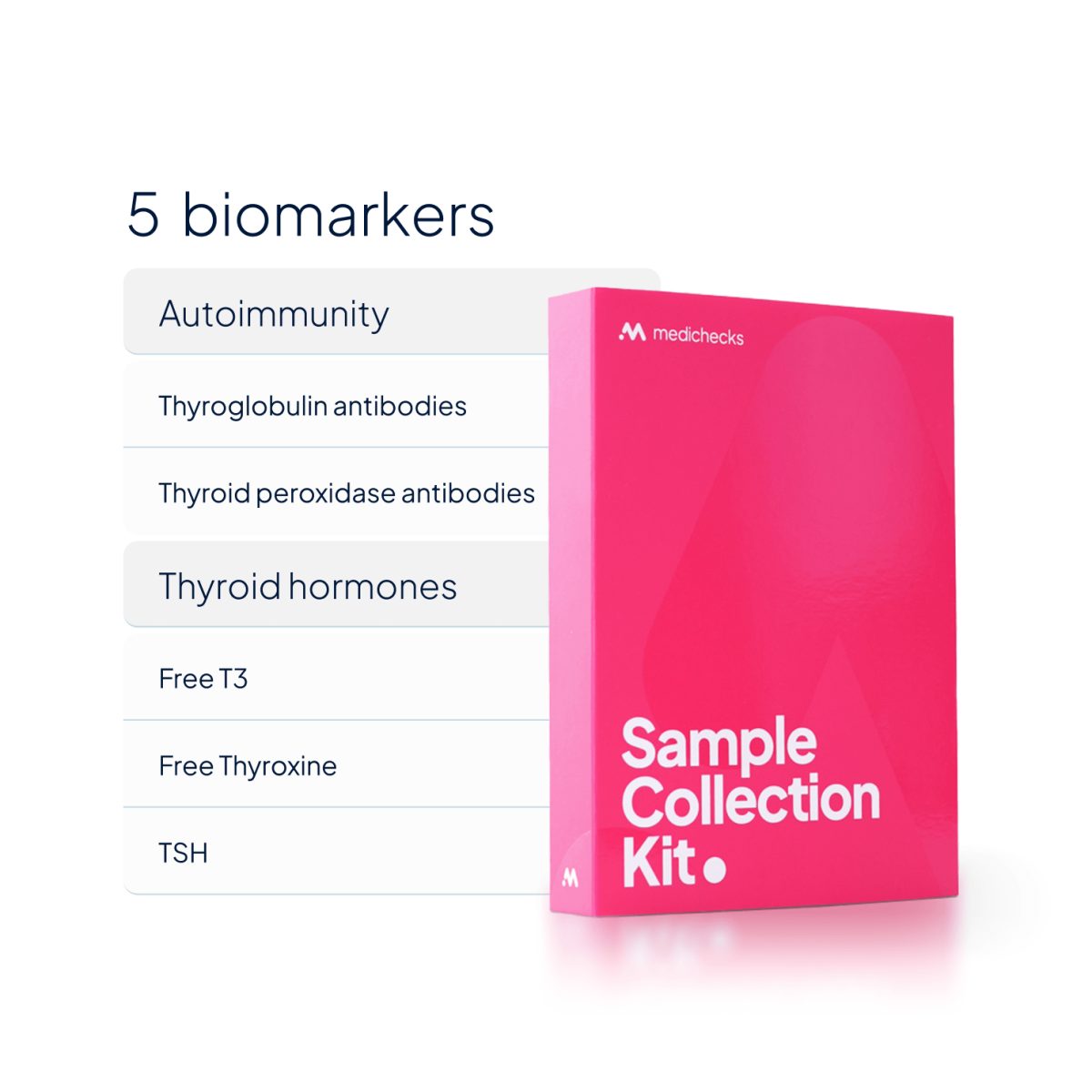
This test includes four markers: thyroid stimulating hormone (TSH); Free thyroxine (FT4); Free triiodothyronine (FT3); and TPO antibodies.
What is the purpose of this test?
The thyroid tests are used to evaluate the function of the thyroid gland; to help diagnose thyroid gland disorders. The thyroid hormones regulate the body's metabolism and how it grows, functions and uses energy.
The thyroid gland is located at the front of the neck. It secretes two hormones known as thyroxine (T4) and tri-iodothyronine (T3). The release of T4 and T3 into the blood is controlled by a third hormone called thyroid stimulating hormone (TSH), this hormone is responsible for keeping T4 and T3 at the right levels. Collectively, these three hormones are referred to as 'thyroid function tests' (TFTs). Our test measures the active portion of T4 and T3 known as free T4 (FT4) or free T3 (FT3).
There are two main conditions that effect the thyroid:
Hypothyroidism (known as underactive thyroid) is when the thyroid glands fails to produce sufficient hormones for health. This can be treated by thyroid hormone replacement.
Hyperthyroidism (known as overactive thyroid) is when the thyroid gland produces too much thyroid hormone. This can be treated by hospital specialist depending on the cause.
Our advanced thyroid test also includes measurement of TPO antibodies. TPO is a protein inside the thyroid gland. TPO antibodies are antibodies made by our immune system that bind to TPO. The majority of people have some TPO antibodies in their blood. High levels of TPO antibodies can indicate that someone may have an autoimmune disease affecting the thyroid.
Preparation
Thyroid hormone levels can vary during the day. For the most consistent results, we recommend taking thyroid tests in the morning.
If you take thyroid medication, take your blood test before taking your dose on the day of testing, unless your doctor has advised otherwise.
Drinking water is encouraged before your test. Being well hydrated can make it easier to collect your blood sample and does not affect your results.
Important: these tests are available for people aged over 18 only. Please collect and post your sample to us Monday-Thursday, to avoid delays over the weekend. In a small number of cases, it may not always be possible to provide a result, please see our terms and conditions for details.
ROYAL MAIL TRACKED 24 SAMPLE RETURN INCLUDED
Who is this test for?
This test is for people who are concerned that they may have a thyroid problem.
Early signs and symptoms of thyroid dysfunction may often be very non-specific. The common symptoms hypothyroidism may include:
- Unexplained weight gain
- Dry skin
- Feeling cold
- Puffy skin
- Hair loss
- Tiredness
Some signs and symptoms of hyperthyroidism may include:
- Fast heart rate
- Anxiety
- Unexplained weight loss
- Feeling hot
- Hand tremors
- Bulging, dry, puffy or irritated eyes
- Difficulty sleeping (insomnia)
What will the result show?
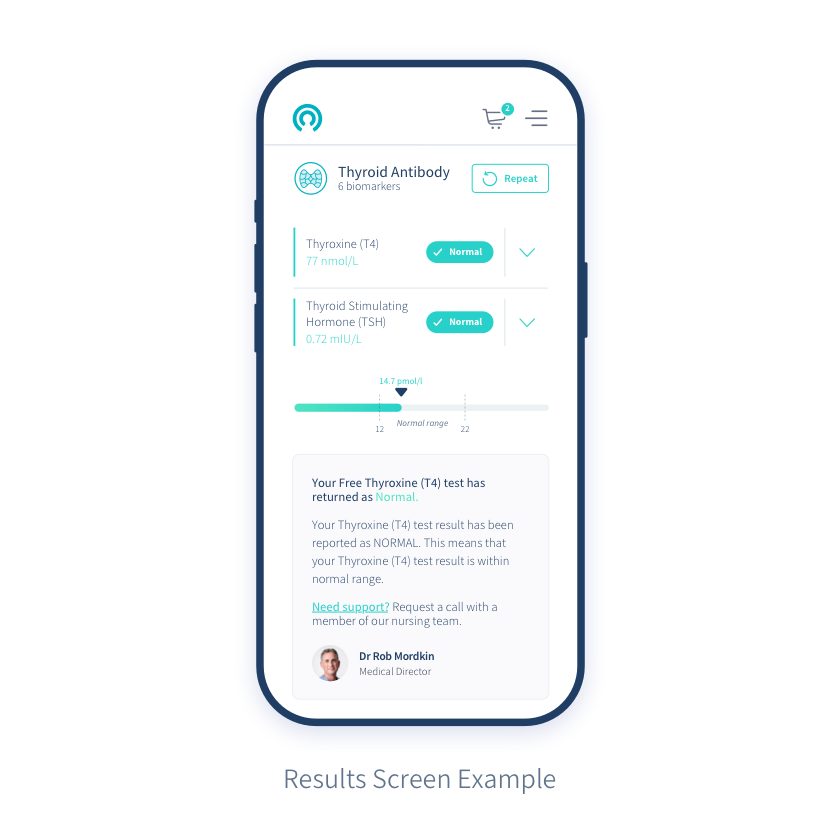
Our thyroid test will report your levels for all three hormones (TSH, FT4 and FT3). You will receive a personalised interpretation of what the results mean and what you should do about them. This may be as simple as; all is well, to a recommendation to see your GP if we detect an abnormality.
In hypothyroidism, the thyroid gland does not produce sufficient thyroid hormone, so the FT4 and FT3 levels are low.
This causes an increase in TSH to try and stimulate the thyroid to produce more thyroxine.
In hyperthyroidism the thyroid gland produces too much thyroxine, so the T4 levels are high. This causes a decrease in TSH to try and stop the thyroid producing more thyroxine.
Thyroid Peroxidase Antibodies (TPO) can help to see if an underactive thyroid is likely to be caused by autoimmune disease. TPO antibodies are especially useful if someone has a mild form of underactive thyroid called subclinical hypothyroidism. If someone has subclinical hypothyroidism and positive TPO antibodies then they may be more likely to develop an underactive thyroid in the future. More information can be found on our TPO test page.
Recent Illness or Infection
Being unwell can impact thyroid test results. We would recommend waiting 3 to 4 weeks after recovering from illness or infection before doing our thyroid tests.
Biotin supplements
Supplements that contain biotin (also known as vitamin B7) can sometimes affect thyroid testing. We recommend leaving the following amount of time between biotin supplement and our blood test:
Less than 10,000 mcg/day (10 mg/day) of biotin - 24 hours
10,000 mcg/day or above (10 mg/day or above) of biotin - 72 hours
Thyroid medication
There is no need to stop taking thyroid medication before doing this test. It will not change the accuracy of the test.
Interpretation of Thyroid tests
We provide comments to help you understand your thyroid results and to tell you when we think you should see your doctor. Our comments only apply to people who have not been diagnosed with a thyroid condition and are not on thyroid medication. This is because the monitoring of thyroid disorders needs to look at results together with how you are feeling e.g. ongoing symptoms. For this reason, we are unable to give advice about treatments or the amount you are taking.
Ticking the "taking thyroid medication" box does not change how we process or analyse the sample. It also does not change the normal ranges we provide. It will just stop us from providing a comment with the result that would likely not be relevant to your individual treatment.
What do the TPO results mean?
From 6 August 2026, the positive threshold for anti-TPO antibodies changed to 21 IU/mL or above (previously 35 IU/mL or above) due to the introduction of a new Roche anti-TPO method. Previous positive and negative results remain valid and do not require reinterpretation.
TPO antibodies of 21 IU/mL or above:
You have raised levels of TPO antibodies. If your thyroid tests show a subclinical hypothyroid pattern, this suggests that you may have a higher chance of developing an underactive thyroid in the future. If you have already been diagnosed with an underactive thyroid, this suggests that this condition is caused by an autoimmune disease affecting the thyroid.
TPO antibodies of 20 IU/mL or below:
You have normal levels of TPO antibodies. If your thyroid tests show a subclinical hypothyroid pattern, this suggests that you have a lower chance of developing an underactive thyroid in the future.
If you have already been diagnosed with an underactive thyroid, this result does not indicate whether or not this condition is caused by an autoimmune disease affecting the thyroid. Up to 1 in 10 people with an autoimmune underactive thyroid condition have TPO antibodies within the normal range (i.e. 20 or below).
I have normal thyroid tests, what does my TPO antibody result mean?
It is not clear what a high level of TPO antibodies means for someone with normal thyroid tests. There is some evidence to indicate that high levels of TPO antibodies could suggest a higher chance of developing an underactive thyroid in the future. However, many people with high levels of TPO antibodies will not go on to develop an underactive thyroid.
I have hyperthyroidism, what does my TPO antibody result mean?
TPO antibodies are present in the majority of people with hyperthyroidism but this is not helpful for determining the cause of hyperthyroidism. If your test results indicate that you have hyperthyroidism then we recommend discussing the result with your doctor.
Why do you not measure thyroglobulin antibodies?
Thyroglobulin antibodies also known as anti-thyroglobulin antibodies are another test related to the thyroid. Studies have demonstrated that TPO antibodies are linked to an underactive thyroid. The same studies found that thyroglobulin antibodies were only associated with an underactive thyroid in people who also had positive TPO antibodies. When thyroglobulin antibodies were found on their own they were not associated with an underactive thyroid. For this reason, we do not feel that measuring thyroglobulin antibodies adds any information above measuring TPO antibodies alone and so is not of benefit to our customers.
Reference ranges
The ranges are represented visually on the chart, when viewed on a desktop pc, so you can see exactly where your result lies in relation to the ranges.
The ranges are:
TSH 0.27 to 4.20 mIU/L
FT4 12.0 to 22.0 pmol/L
FT3 3.1 to 6.8 pmol/L
TPO 21 IU/mL and above is positive
From 6 August 2026, the positive threshold for anti-TPO antibodies changed to 21 IU/mL or above (previously 35 IU/mL or above) due to the introduction of a new Roche anti-TPO method. Previous positive and negative results remain valid and do not require reinterpretation.
Which tests do you use?
Thyroid Stimulating Hormone (TSH) - Roche Cobas Elecsys TSH electrochemiluminescence immunoassay
Thyroxine (T4, free direct) - Roche Cobas Elecsys FT4 III electrochemiluminescence immunoassay
Triiodothyronine (T3, free) - Roche Cobas Elecsys FT3 III electrochemiluminescence immunoassay
Thyroid peroxidase antibodies - Roche Cobas Elecsys Anti-TPO electrochemiluminescence immunoassay
All four tests are analysed on a Roche Cobas e801 analyser
Description provided by Monitor My Health.