UNDERSTAND your ovarian reserve
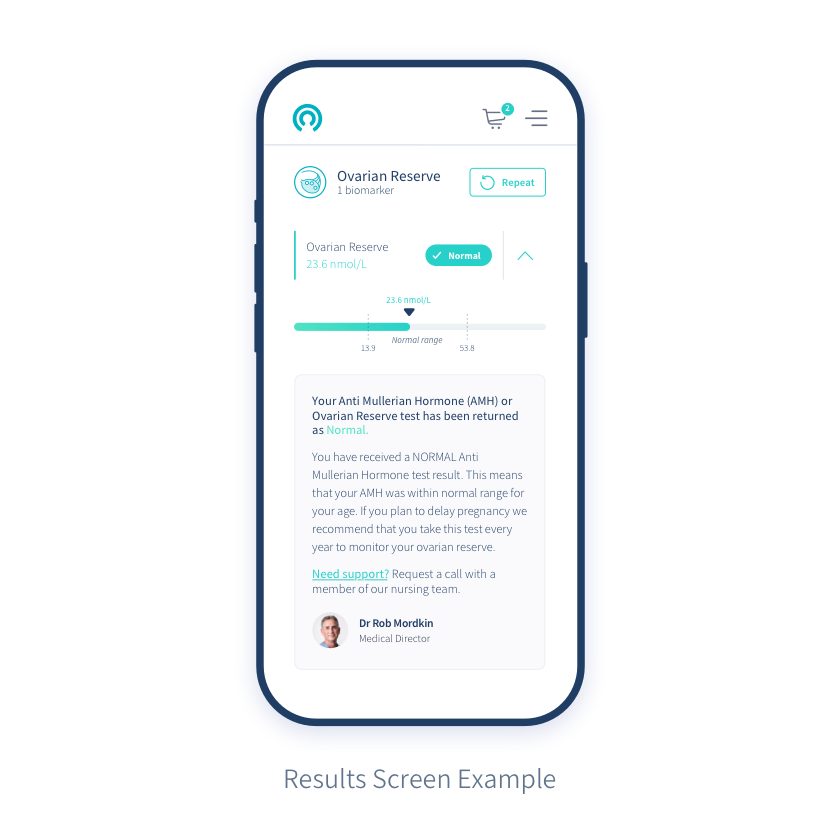
At-home AMH blood test measuring ovarian reserve levels. NHS laboratory testing with reliable results you can share with your clinician.
The AMH (Anti-Müllerian Hormone) blood test is useful if you are considering starting a family and want to know more about your egg count, or if you are considering fertility treatment. It gives an indication of the number of growing follicles (each containing an egg) in the ovaries. Higher AMH levels typically means more growing follicles.
The number of growing follicles and AMH are usually higher in your 20s and decrease as you age. This is related to ovarian reserve, the total number of eggs in the ovaries. However, AMH cannot predict when you will go through menopause.
During IVF or other fertility treatment, AMH can be used to estimate how many eggs will be produced during a treatment cycle. AMH cannot tell us about the quality of eggs or their ability to lead to pregnancy.
What is ovarian reserve?
Ovarian reserve is the number of eggs in your ovaries. Women are born with about 0.5 to 1 million eggs, and this number decreases as they age, leading up to menopause.
AMH doesn't measure the total number of eggs directly. Instead, it indicates how many growing follicles (each containing an egg) you have. During each menstrual cycle, a few follicles begin to grow, and AMH reflects this number.
You can also count these growing follicles with an ultrasound, which is called the antral follicle count (AFC). Both AMH and AFC give an indication of your ovarian reserve.
Polycystic Ovary Syndrome (PCOS)
High AMH levels are often found in women with polycystic ovary syndrome (PCOS), but having high AMH alone doesn't mean you have PCOS. Other factors need to be looked at for a proper diagnosis. If you suspect you have PCOS, it's best to talk to your doctor.
Important: these tests are available for people aged over 18 only. Please collect and post your sample to us Monday-Thursday, to avoid delays over the weekend. In a small number of cases, it may not always be possible to provide a result, please see our terms and conditions for details.
Please note: AMH samples are analysed twice a week. Results may take slightly longer to process compared to other tests.
What do the results mean?
The table below shows an estimate of how many growing follicles might be visible on an ultrasound. Keep in mind that these numbers can vary widely from woman to woman. Please see our section "how accurate is this test?" for more information.
AMH level
Active follicles
4 pmol/L or less
7 or fewer
5 to 16 pmol/L
8 to 15
17 pmol/L and above
16 or more
How accurate is this test?
A published study compared the AMH test we use to the number of growing follicles on ultrasound. This is what they found:
For an AMH of 4 pmol/L or less, approximately 60% of women had 7 follicles or less and 40% had more than 7 follicles
For an AMH of 5 to 16 pmol/L, 10% of women had 7 follicles or less and 60% had 8 to 15 follicles and 30% had 16 or more follicles
For an AMH of 17 pmol/L or above, 1% of women had 7 follicles or less, 24% had 8 to 15 follicles and 75 % had 16 or more follicles.
Data from: Prospective study into the value of the automated Elecsys antimüllerian hormone assay for the assessment of the ovarian growing follicle pool - ScienceDirect
When should I take the test?
An AMH level can be taken at any time during a menstrual cycle.
How do contraceptives affect AMH?
AMH level can be up to 30% lower when using hormone contraceptives including combined oral contraceptive pill, progestin-only pill, hormonal intrauterine device, implant or vaginal ring.
How does AMH change with age?
AMH tends to decrease with age. This table shows the range of expected AMH results found in women of different ages:
Age
Expected Range
20-24
9 to 84
25-29
6 to 70
30-34
4 to 58
35-39
1 to 54
40-44
0 to 39
45-50
0 to 19
Can AMH predict menopause?
AMH level cannot be used to predict when you will go through menopause.
Description provided by Monitor My Health.